Moving with the Moon Cycles

Holidays give us great opportunities for timely word studies. How about a mini study on Lunar New Year? I'm feeling business-y things moving into gear with this new moon, a time celebrated by many cultures in Asia. Perhaps your students also celebrate it with their families? A word family doesn’t have to be particularly big to be fruitful. What words do you notice in this matrix? What are you wondering about?

I’ve created an activity sheet for you to use with students who are ready to learn about this word’s history and relatives. You might enjoy working through the prompts yourself, too!

Steps for a Scientific Word Investigation
Start with meaning! What does the word mean to your students? Having to explain and make connections to prior knowledge is a useful language skill. It also shows when your students really have no idea! Talk together before doing a dictionary dive.
Tell the tale - where did this word come from and what did it mean originally? Knowing this helps us understand the meaning of any word in the family, since they will all contain at least an echo of the historical root's original sense and meaning, otherwise known as the "orthographic denotation."
I like to mark up entries from the Online Etymology Dictionary with students so they can follow the trail back in time. This entry gives two meanings for when 'lunar' first came into English. In the early 15th century, it meant "crescent-shaped", but it took on the notion of "pertaining to the moon" in the 1620s. After that, we head backwards into Old French and finally Latin.

Then I like to turn the entry above into the "data flow diagram" below. Having students create this different style of visual helps them connect to how the word traveled over time, and it's so much easier for them to identify the oldest written root!

What's the structure? Because of the Latin root, students might hypothesize that the word 'lunar' is built with the base <luna> plus a suffix <-r>. That seems to make sense, but for that to be true, we'd want to find at least two other words with an <-r> suffix performing the same function. If students don't yet have a breadth of experience, attesting the affix might lead you down a winding trail that pulls away from the lesson focus. In this case, I've made it easy for them by giving them a matrix! This is a great support for students when they're just beginning. We reduce the cognitive load in some steps, so they can focus on other steps. In this lesson, we're spending time looking at the etymology flow and original meaning.
Use the second page of the worksheet to have students build word sums from the matrix above. Do they know the meaning of the words they're building? Can they use them in a sentence in a way that makes sense? If not, they might need to consult the dictionary!
The base in this family is <lune>. It's actually a free word on its own that means a "crescent-shaped figure," according to the New Oxford. American Dictionary. We can add suffixes to this base, knowing that the final, non-syllabic <e> will be replaced.
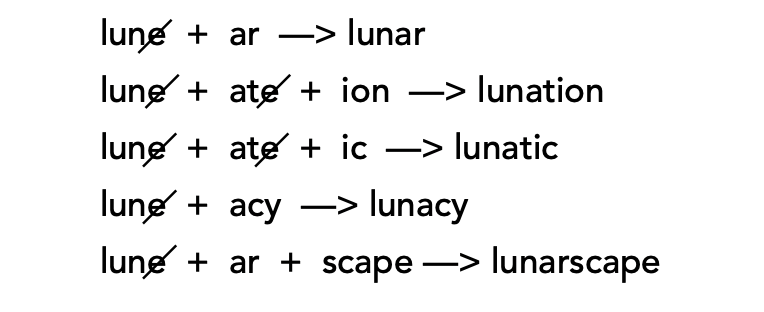
Putting it all together! After creating word sums from the matrix, have your students use the words in oral or written sentences, or create illustrations to accompany their knowledge. Do they understand how to pronounce each word? You might point out how the stress shifts from lunar to lunation.
We can support learning new grapheme-phoneme correspondences with the morphology. The suffix in <lunar> isn't spelled <-er> though it's pronounced the same. Can they find the <-ar> suffix in other words they know?
What about the companion to the lunar year…the solar year? Word studies can lead to more word studies, and that connection offers another word family to explore and maybe sparks a study of calendar systems. Or space exploration! These words are also particularly rich if your students speak a romance language, too, since they share a root and present day spelling. By leaving a bit of an opening for conversation, you'll find out if your student can lead the next lesson direction with a question that piques their interest! After all, authentic engagement is a prime state for learning.


Comments